If you’ve already graduated or are graduating soon, you know the fear of not finding a job all too well. It’s that constant niggling feeling that your applications won’t be good enough and you’ll be stuck looking for work for months on end.
With graduate schemes and entry-level jobs expecting so much experience, and being increasingly competitive, your application has to stand out. You have to tailor your application to the company, do well on online assessments and research the company for any interviews.
The part that comes first, though, is your CV. Nowadays, it won’t get you a job on its own, but a well-written CV can help you get noticed, communicate your experience and give employers a reason to invite you for an interview.
Having recently started applying for graduate schemes myself, I've been editing my CV while learning from leading graduate coach Farrah Morgan about what employers look for when reviewing early-career candidates.
Here are some CV writing tips for graduates, including the structure I'd recommend and a template you can use to get started.
1. Keep Your CV Simple & Clear
My first CV drafts a couple of years ago were so fancy. I made them on Canva, adding all sorts of lines and icons. It wasn't until I started applying for placement schemes last year that I had a reality check: the ATS struggled to read my CV properly and completely disrupted the format.
If you’re not familiar with what an ATS is, it stands for Applicant Tracking System, which is a system employers use to manage applications by scanning and organising CVs based on keywords and qualifications. Essentially, they check how well your CV matches the job role and how suitable you are as a candidate.
CVs with complicated designs, such as excessive graphics, unusual fonts, text boxes, tables and decorative elements, can make information harder for the ATS to read.
The best thing you can do is to use a simple, professional layout:
Use a simple, readable font such as Arial, Calibri or Aptos.
Stick to a consistent font size and formatting throughout.
Use clear headings to separate each section.
Present experience using bullet points rather than long paragraphs.
Avoid graphics, icons, photographs and columns.

Keep your CV simple and professional without any icons or graphics, so the ATS can scan it easily.
We recommend keeping your CV to one or two pages, depending on your experience. You don't need to fill every available space; a concise, relevant CV is much more useful than one packed with information that doesn't add anything.
Remember to save your CV as a PDF to preserve its formatting when you upload it, unless the employer specifically requests another format.
2. Write a Personal Profile That Actually Says Something
Your personal profile is a short introduction at the top of your CV, giving employers an immediate understanding of who you are and what you offer. I always found this the most stressful part to write, but all you need to do is write about 3 or 4 sentences, explaining your current position, most relevant experience, strongest attributes and career interests.
Avoid including vague descriptions such as "hard-working, enthusiastic and motivated individual". These words could describe almost anyone, so they don't tell an employer much about you.
Here’s an example of a strong personal profile:
Analytical and entrepreneurial final-year Psychology student with 3+ years of digital marketing experience and an interest in consumer behaviour, brand building and product innovation. Combines psychological insight with data-driven decision-making to develop audience-focused marketing strategies. Experienced in content creation, campaign analysis and digital brand development. Now seeking to bring this blend of consumer understanding, analytical thinking and entrepreneurial drive to the Marketing Graduate Scheme.
Your profile should reflect the opportunity you're applying for. If you're interested in finance, you might highlight numerical ability and analytical thinking, whereas for a marketing position, commercial awareness and creativity may be more relevant.
3. Include Relevant Education Info
If you're applying for graduate opportunities, your education is likely to be one of your strongest selling points. Employers value relevant experience, and while that’s the majority of your CV, your education still needs a designated section.
Include your university, degree title, expected graduation date and academic results. You can also mention relevant modules, dissertation research, academic awards and projects that demonstrate skills related to the role.

Include details about your university grades, modules and any relevant projects, as well as your A-level and GCSE grades.
Add all your A-level subjects and the grades you achieved, as well as the total number of GCSEs you completed and the range of grades. It's also worth specifying your individual grades in English and Maths, as employers may look for these when assessing applications.
4. Turn Your Experience Into Achievements
Many applicants make the mistake of simply listing their responsibilities. However, employers want to understand what you actually achieved and how you contributed.
Instead of writing:
Responsible for managing social media accounts.
Helped organise university events.
Worked with customers and handled enquiries.
Try:
Developed social media content that increased Instagram followers by 39% over three months.
Coordinated a university event attended by 150 students, managing planning, promotion and logistics.
Resolved customer enquiries and processed transactions in a fast-paced retail environment.
Always give evidence of what you did, and include measurable results, such as percentages, revenue, audience growth, number of clients or projects completed.
If you don't have numerical results, explain what you delivered, who it benefited and what skills you demonstrated.
A useful structure is: action verb + what you did + how you did it + the result or impact.
If you’re panicking about not having enough work experience, remember that any experience can be included as long as it demonstrates skills relevant to the job. University societies, volunteering, personal projects, competitions, sports teams and part-time jobs all count.
The important thing is to describe these experiences professionally and explain what you actually did.
5. Include Skills That Are Relevant to the Role
Rather than creating a long list of generic skills, organise them into categories and include any of the exact ones you have that are mentioned in the job description.
For example:
Technical/Tools: Excel, PowerPoint, Google Analytics, Python, AutoCAD or other relevant software.
Industry-Specific: Financial modelling, laboratory techniques, SEO, programming or research methods.
Analytical: Data interpretation, statistical analysis, problem-solving and critical thinking.
Professional: Project coordination, stakeholder communication, teamwork and presentation skills.
Languages: English (native) and Spanish (fluent).
Be picky and only include skills you can confidently discuss if an interviewer asks you to demonstrate them.
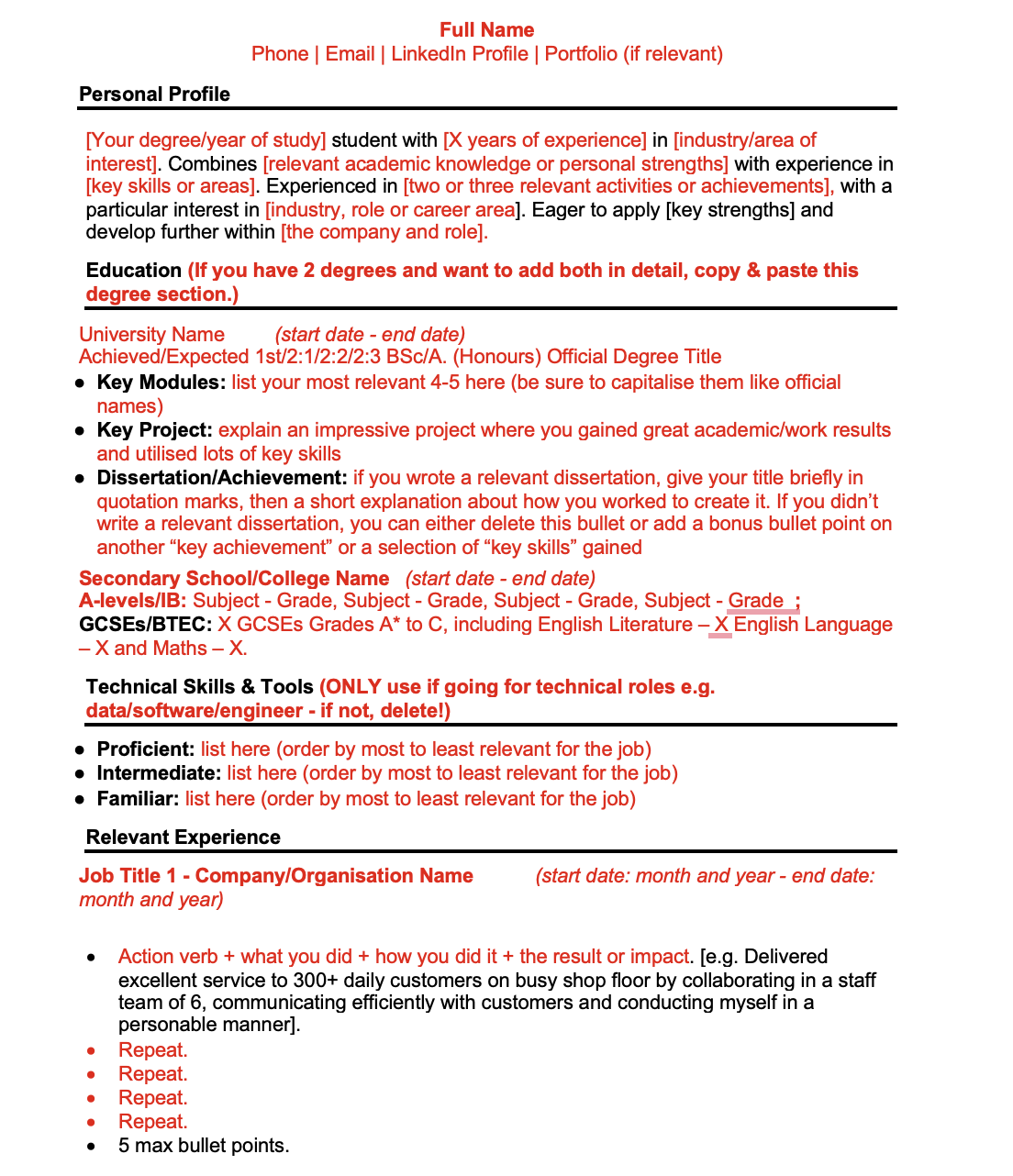
If you're unsure where to begin, use the structure below as a starting point. You can adapt it for graduate schemes, placement years, internships and entry-level jobs.
Writing a graduate CV can feel intimidating, particularly when you're competing against candidates with different experiences and qualifications, so we hope this guide has helped you feel more capable.
Our biggest piece of advice is to stop thinking about your CV as a record of everything you've done and start treating it as an explanation of why those experiences make you a suitable candidate.
Want More Career Advice?
If you’re looking for more advice on applications or figuring out what you want to do next, have a read of our other free lifestyle articles.
At Sofia Magazine, we're bringing back online magazines and blogging. We write about the things that matter as you find your way through your teens and twenties, focused on beauty, fashion lifestyle and wellbeing.
Our Winter Issue is landing this December! Pre-order now or get every seasonal issue with The Exclusive subscription.
Join The Loyal Edit Newsletter
Stay up to date with our newest articles, every week, straight to your inbox.